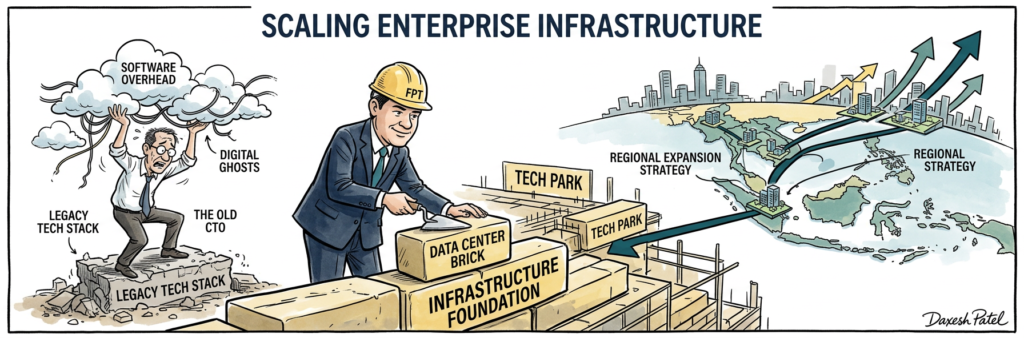
The FPT Corporation’s proposed $338 million investment in a Da Nang tech park is not just another facility; it is a signal that digital infrastructure must be managed as a tangible asset class, equivalent to a physical manufacturing plant, rather than an intangible software overhead. Most enterprise leaders view regional tech hubs through the lens of cheap labour or proximity to market, but this framing is obsolete in 2026. If you are treating this—or any similar expansion—as a cost-saving exercise, you are effectively betting your company’s future on the assumption that global supply chains will remain static while intelligence becomes increasingly local and agentic.
The prevailing consensus among my peers in the C-suite is that “digital” is a fluid, decentralised utility. This mindset results in suboptimal resource allocation, where companies chase talent corridors without securing the underlying data sovereignty or infrastructure readiness. When you view digital presence as an abstract overhead, you inevitably defer the hard work of building robust, localised data pipelines. I have seen this strategy lead to a classic failure mode: the company arrives in a new market with a full suite of cloud-based AI tools, only to find that its operational systems lack the data maturity to feed the very agentic workflows it intends to deploy.
The Structural Flaw in Current Expansion Logic
Most leaders default to an “asset-light” expansion model because it is easier to report to a board of directors. It requires no heavy lifting regarding infrastructure or physical data architecture. However, the commercial cost of this laziness is mounting. In 2026, as operational AI shifts toward agentic models—systems that don’t just provide insights but execute tasks—the bottleneck is no longer processing power; it is the physical and logical proximity to the data source.
If your AI agents are constantly reaching across oceans to access fragmented, latency-heavy, or non-compliant datasets, your operational efficiency will never reach the threshold required for meaningful automation. You are paying a “latency tax” on every decision your automated agents make. My experience managing £30M+ budgets has taught me that infrastructure is the bedrock of performance. When you ignore the physical reality of where your data lives and how it is ingested, you are building a house on shifting sands.
The Data Readiness Gap
The market is currently fixated on labour costs in Southeast Asia, ignoring three critical realities of the 2026 landscape that should define your capital expenditure:
- The Agentic Latency Floor: The move from passive LLMs to agentic AI workflows requires near-zero latency for mission-critical tasks. Placing your compute infrastructure in a facility like the Da Nang tech park isn’t just about presence; it is about bringing the model to the data. Strategic implication: move your edge compute closer to the manufacturing floor.
- Data Sovereignty as a Competitive Moat: Emerging markets are tightening data residency requirements. FPT’s investment isn’t just a park; it’s a sandbox for local compliance. Decisions should shift from “where is it cheapest to host” to “where can we legally and operationally process this data.”
- The Talent Pipeline Premium: We are past the point where a local university degree suffices. The 2026 requirement is for engineers capable of “systems orchestration”—people who can bridge the gap between hard manufacturing processes and software agents. Invest in partnerships that move beyond internships to co-developed curriculum.
- Interoperability over Extensibility: Most firms are buying software that is too broad. The strategic winning move is to invest in infrastructure that prioritises deep interoperability with legacy manufacturing stacks, rather than standardising on generic enterprise SaaS.
Strategic Comparison of Expansion Models
| Conventional Leader Response | Research Finding | Strategic Risk of Inaction | Better Approach |
|---|---|---|---|
| Centralised cloud hosting | Agentic AI demands localized edge compute | Operational lag in real-time execution | Hybrid edge-to-core architecture |
| Outsourced talent recruiting | Orchestration skill gap is critical | Failure to integrate AI workflows | Direct vocational co-investment |
| SaaS-first procurement | Legacy-data readiness is the bottleneck | Unusable data ‘dark pools’ | Data-engineering-first architecture |
| Uniform global SOPs | Regional data compliance is evolving | Regulatory shutdown of operations | Locally-governed compliance pods |
Decision Framework: Prioritising Infrastructure
What Leading Teams Understand Earlier
The organisations I see winning in this new environment are those that treat their digital footprint as a physical expansion. First, they focus on “Data Gravity.” They understand that compute must chase the data, not the other way around. By establishing regional hubs early, they ensure that their AI agents have the proximity needed to make high-velocity decisions without incurring the bandwidth costs of global traffic.
Second, they treat talent as an internal supply chain. Instead of competing for existing, expensive specialists on the global market, they build the pipeline locally. This involves embedding their own engineers into local technical universities to shape the curriculum, ensuring the graduates are fluent in the exact tech stack the company requires. It is an asymmetric advantage that costs little to start but pays dividends in year two and beyond.
Finally, they treat “Infrastructure as a Product.” The tech park is not just space; it is an internal service. They build APIs that allow their local factories to plug into global workflows without friction. They don’t just “go digital”; they engineer the hardware-software interface to ensure that every sensor in a manufacturing plant is feeding a clean, usable data stream directly into their agentic models.
Leadership Recommendations for Resource Allocation
- Commit to a Regional Infrastructure Audit: Map every major node in your operation and calculate the latency of your current AI workflows. Delaying this keeps you vulnerable to competitive AI agents that operate at lower costs and higher speeds. Early evidence of success: a 15% reduction in compute costs within six months.
- Pivot Capital from SaaS to Data Engineering: Stop buying more seats for generic enterprise tools. Shift that budget toward cleansing your internal datasets and building robust local ingestion layers. Waiting one more quarter risks further corrupting your data lake. Success looks like higher accuracy scores for your LLM outputs.
- Deep-Link with Regional Education: Sign a firm memorandum of understanding with one high-potential university near your next project site. If you delay, you leave the best talent to your competitors. Evidence of success: an 80% placement rate of local graduates into your junior engineering roles.
- Architect for Sovereignty: Design your next data centre or hub around the strictest regulatory requirements in the region. This future-proofs your operations against shifting laws. If you wait for the legislation to pass, you will face an emergency migration. Early signal: successful pilot of a local, self-contained data pod.
- Measure “Agent Execution” as a KPI: Move beyond “time saved” metrics. Start tracking “number of tasks executed by agents” per day. If the number is low, your infrastructure is the culprit. Success looks like an exponential curve in agent output, not a linear one.
The FPT initiative highlights that the future of digital competition is increasingly tied to the physical world. We are moving away from an era of “everything everywhere” towards an era of “local precision.” The organisational friction you will face—the CFO asking why you are investing in “buildings” rather than “more software licenses”—is exactly the friction you need to overcome to secure a competitive advantage.
If your digital strategy looks exactly the same as it did in 2024, you aren’t just standing still—you are actively losing the ability to compete in the next decade of agentic automation. You must build your digital future as if it were a physical asset, or you will find yourself paying rent to those who did.
- Is a digital tech park still relevant in an era of cloud-first computing?
- Absolutely, because the cloud is no longer sufficient for low-latency, mission-critical agentic AI. As AI agents move from chat to execution, the physics of data transport become a hard competitive limit that only localized infrastructure can solve.
- Why shouldn’t I just rely on offshore talent for my AI development?
- Offshore talent is excellent for coding, but inferior for systems orchestration within your specific operational context. You need engineers who understand your manufacturing processes, and you can only secure that through deep local integration.
- Isn’t it cheaper to buy enterprise-ready AI software rather than build data pipelines?
- Buying is cheaper in the short term, but you are buying a black box that cannot be optimised for your unique operational data. You will eventually face a “readiness wall” where the software is capable, but your data is too messy to be useful.
- How do I justify this capital expenditure to a board that expects ‘asset-light’ margins?
- Present this as risk mitigation and long-term operational efficiency, not as a standard real-estate cost. The cost of failing to localise your AI agents will manifest as an uncompetitive cost-to-serve that no SaaS subscription can hide.
- What is the biggest mistake leaders make when entering Southeast Asian tech corridors?
- The biggest mistake is viewing these regions solely as a source of cheap labor. If you don’t bring your own infrastructure and engineering depth, you will only capture the commoditized tasks while losing the high-value orchestration work to local competitors.