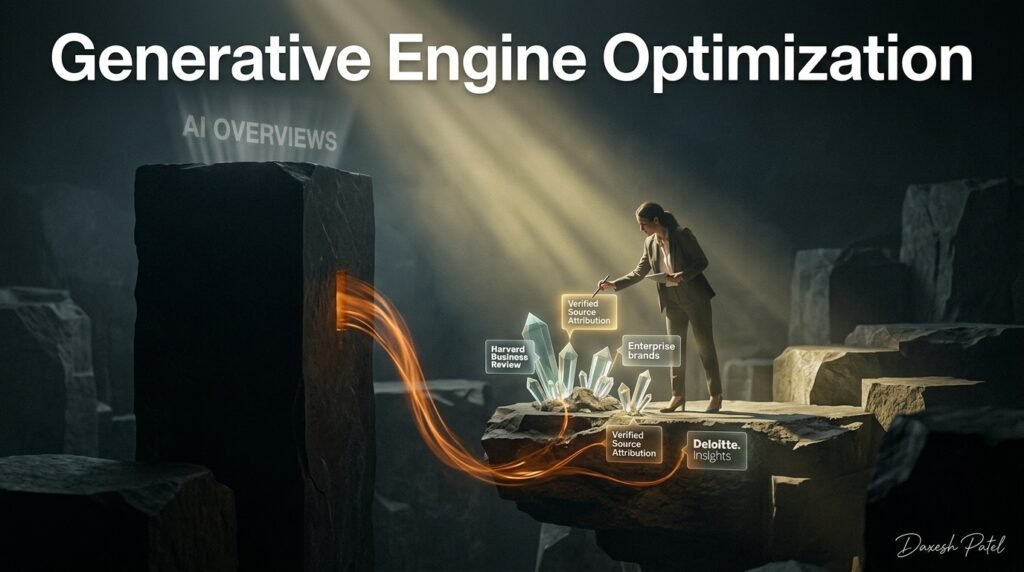
Beyond the Basics – Setting the Commercial Imperative
I’m Daxesh Patel. After more than two decades running digital transformation and AI automation for global brands, my focus is simple: measurable commercial impact. Generative Engine Optimization, incorporating Moving from traditional rank tracking to citation and source-based visibility is now mandatory for enterprise SEO performance., AI models prioritize entities and trusted brand signals over pure backlink volume, requiring a fundamental shift in technical SEO.
That sentence isn’t academic. It defines a hard commercial requirement: your SEO programme must deliver identifiable source authority and measurable outcomes — not just higher positions on a keyword list. I treat AI Overviews as a measurable channel; the aim is to convert model citations into attributable revenue and customer acquisition.
Deconstructing the Search Intent: What Decision-Makers Really Need to Know
Senior leaders want three things from SEO: predictable top-funnel demand, lower acquisition cost, and reliable revenue attribution. AI models surface answers by citing entities and trusted sources; decision-makers need visibility into which of your pages are being treated as sources and why.
I map intent by aligning buying-stage queries to pages that can be cited as sources (product spec pages, data reports, author pages, patents). That mapping changes prioritisation: it elevates authoritative, sourceable content and technical work that communicates trust to models and humans alike.
Data-Driven Foundations: Auditing for Enterprise-Scale Gaps and Opportunities
An enterprise audit must go beyond keyword spreadsheets. I combine crawl and server logs, structured-data inventories, an entity-affinity map, and a citation-trace from sampled generative responses to identify where your site is seen (or ignored) as a source.
Deliverables I expect from this work: a ranked list of pages by commercial influence, a source-citation inventory, a technical debt register focused on canonical and schema failures, and an entity-authority scorecard. These outputs create a playbook that ties technical fixes to commercial uplift.
Strategic Optimisation Pathways: Prioritising for Tangible Commercial Impact
Prioritisation must be driven by commercial delta. I sequence work to protect and grow pages that influence MQLs and revenue first, then expand source coverage into adjacent categories.
Core pathways I deploy: harden source signals (consistent canonicalisation, persistent identifiers, schema and author provenance), create defensible source assets (data sets, reproducible methodologies, stable PDFs), and repair technical artefacts that confuse model ingestion (duplicate content, inconsistent structured data).
Measuring Success: KPIs Beyond Rankings
Rank reports are a vanity metric for an AI era. Below is a practical comparison to reframe your dashboard toward commercial outcomes.
| Traditional SEO Metric | Commercial KPI |
|---|---|
| Traffic Volume | MQLs from Organic Search |
| Keyword Ranking | Organic Revenue Contribution |
| Backlink Count | Branded Citation & Trusted Source Mentions |
| Pageviews | Conversion Rate on Target Pages |
| Bounce Rate | Assist Conversions & Revenue Attribution |
| Domain Authority | Entity / Brand Trust Score |
Operationalise these KPIs in your executive reports and set sprint targets (e.g., citation capture rate, MQL growth from source pages) rather than chasing rank percentiles.
The AI Advantage: Enhancing SEO Efficiency and Insights
AI is not an interruption — it’s an efficiency and insight layer. When applied to SEO workflows it accelerates discovery, surfaces citation opportunities, and automates repetitive production tasks while improving attribution clarity.
Start with a focused pilot on top revenue pages, measure citation capture and MQL lift, then scale. The ROI is visible in shorter research cycles, higher-quality citations and cleaner attribution.
Conclusion: Your Actionable Blueprint for Sustainable Growth
To execute quickly: audit for source visibility, rank pages by commercial influence, fix canonical and schema failures, create sourceable assets, and run an AI-enabled pilot to prove citation-to-revenue. I prioritise interventions that change commercial KPIs within 3–6 months.
If you’re a CMO or Head of Growth looking for pragmatic, hands-on leadership to rewire SEO for an AI-first world, I build and lead programmes that translate these steps into measurable revenue. Reach out to discuss an interim or consultancy engagement.
- How does enterprise SEO differ from small business SEO in terms of ROI?
- Enterprise SEO focuses heavily on revenue attribution and market share capture, with complex technical infrastructure and multi-team dependencies. That complexity makes ROI measurement more intricate but ties outcomes to larger commercial objectives.
- What’s the most common mistake C-suite executives make regarding their SEO strategy?
- The most common error is treating SEO as a tactical content or IT task rather than a strategic commercial channel, which leads to under-investment and poor integration with acquisition and product teams. This prevents SEO from delivering predictable revenue impact.
- Can AI truly automate significant portions of enterprise SEO without human oversight?
- AI can automate research, tagging, and repetitive content tasks and surface citation opportunities, but strategic judgement and governance still require experienced human leadership. Human oversight is essential to maintain brand integrity and commercial relevance.