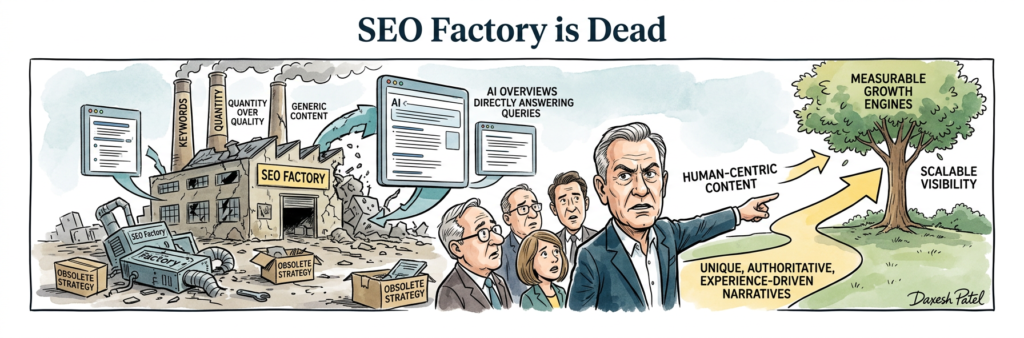
The prevailing wisdom suggests that for an enterprise to command organic visibility, its content strategy needs to pivot towards something vaguely termed ‘human-centric’. Many interpret this as a directive to simply write more, or to inject a subjective ‘voice’ into every piece. From my two decades architecting and executing global growth systems, I can tell you this common belief is a dangerous misdirection. What passes for human-centric content often translates into an expensive, unstructured output that delivers minimal commercial impact and fails to move the needle on heavy-hitting metrics like ROAS or pipeline velocity.
My field observations consistently show that true human-centric SEO isn’t about soft metrics or philosophical alignment; it’s a rigorous, measurable framework designed to capture specific user intent, build undeniable authority, and ultimately, convert. This isn’t about producing content for content’s sake; it’s about engineering a strategic asset. This article will demonstrate how to transition from generic, volume-based tactics to a commercially viable human-centric content strategy, grounded in operational efficiency and demonstrable ROI for organisations scaling to 100M+ visits.
The Flawed Default: Chasing Volume Over Value
The most common mistake I encounter among enterprise marketing teams isn’t a lack of effort; it’s a misapplication of resources, fixated on what I call ‘SEO factory’ tactics. This typically involves scaling content production to hit perceived keyword volume targets, often outsourced, with little regard for depth, unique insight, or direct commercial alignment. The mechanistic failure here is straightforward: producing hundreds of articles that superficially cover topics, relying on low-cost writers, and prioritising quantity over demonstrated expertise. This approach was perhaps tenable years ago when SERPs were less sophisticated, but in the age of AI Overviews, it’s a guaranteed path to obscurity.
Consider the decision point: do you commission fifty generic articles covering variations of a broad topic, each costing £200, or do you invest that same £10,000 into five truly authoritative, experience-driven pieces, replete with original research, interactive elements, or proprietary data? The flawed default consistently chooses the former, believing more ‘shots on goal’ will yield more conversions. What it actually yields is content bloat, increased maintenance costs, and diluted domain authority. The commercial implication is stark: capital expenditure that fails to contribute meaningfully to ROAS improvements or demonstrable revenue uplift, becoming a sunken cost rather than a strategic investment.
What the Data Actually Shows: Beyond Generic Visibility
My work across global enterprise clients has repeatedly demonstrated that sustainable enterprise SEO now demands a radical shift towards creating unique, authoritative, and experience-driven content that directly addresses specific user intent beyond what AI can synthesise. The proof is in the commercial metrics. For instance, by architecting and executing complex growth systems that prioritised deep-dive, truly valuable content over generic fodder, I’ve overseen programmes that achieved 123% ROAS uplifts. This wasn’t achieved by chasing long-tail keywords with templated articles. It came from identifying critical intent gaps in the market, then deploying resources to fill those gaps with content so distinctive and useful that it commanded attention, built trust, and led directly to conversions.
Furthermore, managing marketing budgets exceeding £30M requires an unwavering focus on efficiency and measurable outcomes. When we shift from a volume-based content strategy to one centred on authentic expertise, we see direct correlations to budget efficiency. Instead of spreading budget thinly across hundreds of underperforming assets, we concentrate investment into fewer, higher-impact pieces that act as magnets for high-value traffic. This approach doesn’t just improve brand visibility; it drives significant year-on-year enterprise growth, reflected in tangible metrics like increased conversion rates and customer loyalty that directly impact the bottom line.
Comparison Table
| Common Practice | What It Produces | Better Approach | Expected Outcome |
|---|---|---|---|
| Mass content creation for broad keywords. | High volume of generic, undifferentiated content; diluted authority. | Strategic content architecture addressing specific, underserved user intent. | Superior organic rankings for high-value queries; reduced content bloat. |
| Focus on basic keyword density and superficial topic coverage. | Content easily replicated or synthesised by AI Overviews; low user engagement. | Experience-driven content with proprietary data, expert insights, and unique UX. | Increased dwell time and direct conversions; immunity to AI summarisation. |
| Measuring success by traffic volume alone. | Inflated vanity metrics; unclear contribution to commercial goals. | ROI framework focusing on brand equity, engagement quality, and conversion rates. | Demonstrable ROAS uplift and revenue attribution from organic channels. |
| Treating AI as a replacement for human writers or as a simple content generator. | Production of generic, uninspired content lacking authentic human expression. | Leveraging AI tools as collaborators for ideation, research, and enhancing human expression. | Scalable production of genuinely unique, human-centric content with operational efficiency. |
| Generic content formats (blog posts, basic articles). | Limited differentiation; inability to capture diverse user preferences. | Diverse content formats: interactive tools, video-first strategies, original data visualisations. | Enhanced user engagement, increased shareability, and broader audience reach. |
Performance Benchmarks for Enterprise Growth
What Experienced Operators Do Differently
My experience leading global teams and managing multi-million-pound budgets has taught me that the delineation between a failing content strategy and a commercially successful one isn’t subtle. It’s a fundamental difference in approach:
- From Compliance Exercise to Commercial Asset: Most teams treat content creation, even under a ‘human-centric’ banner, as a compliance exercise—a task to be checked off. Experienced operators, however, view every piece of content as a potential commercial asset. They don’t just ask if it’s ‘good’; they demand to know its projected ROI, its role in the conversion funnel, and its capacity to either reduce customer acquisition cost or increase customer lifetime value. This decision difference is about intent: are you producing to exist, or producing to profit? The former drains resources; the latter compounds returns, directly affecting quarterly revenue targets.
- From Generic Content Mills to Niche Authority Hubs: The flawed default scales by replicating generalist content. True operators scale by identifying granular market needs and building unparalleled authority within those niches. This means investing in subject matter experts, original research, proprietary tools, and detailed methodologies that others cannot easily replicate. For a global enterprise, this translates into building market-specific architectures where content isn’t merely localised, but truly endemic, reflecting deep cultural understanding and addressing hyper-specific intent. This reduces operational friction in local markets by delivering genuinely valuable resources, significantly reducing time to market and improving regional performance metrics.
- From Superficial UX to Immersive Experiences: Many content strategies stop at the words on the page. True commercial impact in the AI era comes from strategic content architecture and sophisticated UX enhancements. This means considering how a user interacts with the information, not just what the information is. Think interactive data visualisations, dynamic tools, video-first strategies, and streamlined user journeys. These aren’t ‘nice-to-haves’; they are essential for capturing attention, building trust in an age of AI Overviews, and driving direct conversions. Such UX improvements can dramatically lower bounce rates and increase conversion rates, directly boosting sales pipeline efficiency.
- From Reactive Optimisation to Proactive System Design: Instead of endlessly tweaking existing content based on fluctuating SERP signals, experienced operators design scalable organic acquisition systems. This involves predictive analysis of market trends, identifying future intent gaps, and proactively building content architectures that anticipate user needs. It’s about creating durable assets, not transient ones. This foresight reduces long-term operational costs by minimising constant re-optimisation efforts and ensures a steady, predictable flow of qualified organic traffic, which translates into more stable and predictable revenue streams.
The core difference is an unflinching focus on commercial outcomes, applying an operational rigor to content that many reserve for paid media or product development. It’s the difference between merely producing content and strategically engineering growth.
Five Prioritised Actions for Enterprise Human-Centric SEO
-
Map User Intent to Commercial Outcomes with Precision
What to do: Go beyond generic keyword research. Conduct deep-dive user psychology analysis to understand the underlying ‘why’ behind search queries, specifically at the mid-to-lower funnel. Identify intent clusters that signal commercial readiness. For each cluster, define the specific business metric (e.g., lead quality, direct sales, trial sign-ups) that successful content in that cluster should move. This involves interviewing sales teams, analysing customer support logs, and examining conversion path analytics.
Why it produces the outcome: This shifts content creation from an abstract exercise to a direct revenue driver. By aligning content strategy directly with conversion points, you ensure every piece is engineered for commercial impact, not just visibility. It also informs your team where to focus for maximum ROAS.
Common failure mode: Stopping at keyword volume and difficulty, assuming generic informational content is enough. This leads to high traffic but low conversion rates, burning budget without ROI.
Metric that moves first: Conversion rates for specific content clusters; lead qualification rates.
-
Architect Content for Unmistakable Authority and Experience
What to do: Stop producing content that an AI can easily synthesise. This means investing in unique data (surveys, proprietary research), original perspectives (expert interviews, thought leadership), and rich media experiences (interactive tools, calculators, bespoke video content, 3D visualisations). Design content to showcase your brand’s unique expertise and build trust that AI Overviews cannot replicate. Implement sophisticated UX enhancements that make consuming complex information effortless and engaging.
Why it produces the outcome: This directly addresses the psychological impact of AI Overviews on user trust. Users are increasingly skeptical of generic, undifferentiated information. Truly authoritative content cuts through this noise, establishing your brand as the definitive source. The enhanced UX captures and retains attention, critical for driving deeper engagement and brand loyalty. This translates to stronger domain authority and a more resilient organic presence, safeguarding future organic traffic against SERP changes.
Common failure mode: Believing ‘long-form’ or ‘well-written’ equates to authority, without genuine unique insight. This results in expensive content that still gets outranked or summarised by AI.
Metric that moves first: Dwell time, engagement rate, branded search volume, backlink acquisition from authoritative sources.
-
Implement ROI Frameworks Beyond Traffic
What to do: Develop clear, quantifiable frameworks for measuring the ROI of human-centric content. This involves tying specific content pieces to micro-conversions, assisted conversions, and ultimately, direct revenue. Track metrics like ‘cost per qualified lead from organic content’, ‘customer lifetime value (CLTV) of organic content users’, and ‘brand equity uplift via sentiment analysis and share of voice’. Assign attribution models that account for the long conversion paths often influenced by high-value content.
Why it produces the outcome: This shifts content from a cost centre to a measurable profit centre. By quantifying its commercial impact, you justify budget allocation, demonstrate tangible ROAS, and provide clear accountability for content teams. It allows senior leaders to make data-driven decisions on where to invest for maximum commercial returns. This directly supports the goal of driving year-on-year enterprise growth.
Common failure mode: Relying on abstract metrics like ‘impressions’ or ‘overall traffic’ that do not directly correlate with commercial success. This perpetuates a lack of accountability and misallocation of resources.
Metric that moves first: Content-attributed pipeline value, cost per acquisition (CPA) from organic, ROAS of content initiatives.
-
Integrate AI as a Human Collaborator, Not a Replacement
What to do: Develop advanced protocols for using AI tools for ideation, competitive analysis, trend spotting, and augmenting human expression, not replacing it. Train your teams to use AI for hypothesis generation, identifying gaps in existing content, summarising vast research, and generating diverse outlines that human experts can then infuse with unique insights and experience. Focus on AI for operational efficiencies in the *early stages* of the content lifecycle, freeing up human experts for deep original thought and quality control.
Why it produces the outcome: This maximises operational efficiency without compromising the human-centric quality crucial for competitive advantage. By offloading repetitive or data-heavy tasks to AI, your human experts can focus on strategic thinking, creativity, and adding the distinctive, empathetic touch that resonates with users and outmanoeuvres AI-generated generic content. This significantly reduces content production time and cost, improving budget efficiency.
Common failure mode: Using AI to write entire articles or sections, resulting in bland, unoriginal content that performs poorly in SERPs and fails to connect with users.
Metric that moves first: Content production efficiency (time/cost per high-quality asset), editor review time, human resource allocation optimisation.
-
Operationalise Global Content Scaling and Localisation
What to do: For enterprises operating globally, develop robust, market-specific content architectures. This is more than translation; it’s about cultural relevance, local intent nuances, and understanding regional competitive landscapes. Implement a centralised strategy with decentralised execution, empowering local teams with frameworks and guidelines while ensuring they have the autonomy to create genuinely relevant content. This might involve bespoke research for each region, or local expert interviews that resonate with specific demographics.
Why it produces the outcome: Generic global content dilutes impact. A truly localised human-centric approach ensures content resonates deeply with diverse audiences, building regional authority and driving conversions in specific markets. This prevents operational friction, streamlines global content deployment, and scales organic acquisition at the enterprise level, contributing to the goal of 100M+ visits year-on-year growth across diverse geographies.
Common failure mode: Simply translating content or relying on a single ‘global’ content calendar, missing critical regional opportunities and cultural nuances.
Metric that moves first: Regional organic traffic growth, country-specific conversion rates, local search visibility improvements.
The shift to human-centric SEO is not merely a philosophical inclination; it is a commercial imperative for any enterprise serious about sustainable organic growth in the AI era. My experience leading global campaigns has unequivocally demonstrated that true commercial impact isn’t found in superficial engagement metrics, but in the rigorous application of frameworks that tie every content decision to measurable ROAS, budget efficiency, and revenue uplift. Ignoring this means ceding ground to competitors who understand that content, when engineered correctly, is a potent growth engine, not a mere marketing expense.
Most organisations will continue to chase volume, producing undifferentiated content that will increasingly be overshadowed by AI Overviews and human-authored expertise. This creates a significant opportunity for those willing to invest in strategic content architecture, sophisticated UX enhancements, and the operational rigour necessary to scale these initiatives for profound, measurable enterprise growth. The time for generic content is over; the era of strategic, commercially grounded human-centric SEO has arrived.
Transform your organic acquisition strategy.
FAQ
- What defines a commercially viable human-centric SEO strategy for enterprise?
- It’s defined by its direct contribution to heavy-hitting commercial metrics like ROAS, conversion rates, and pipeline value, achieved through unique, authoritative content designed for specific user intent and supported by advanced UX, rather than just traffic volume.
- How do AI Overviews impact traditional content strategies, particularly for large enterprises?
- AI Overviews are fundamentally transforming SERP dynamics, rendering the traditional volume-based, generic content strategy obsolete for enterprises seeking organic visibility. They necessitate a radical shift towards creating unique, authoritative, and experience-driven content that directly addresses specific user intent beyond what AI can synthesize.
- Can you provide examples of advanced AI integration in content creation?
- Advanced AI integration involves using tools as collaborators for ideation, comprehensive competitive analysis, identifying content gaps, and augmenting human expression. It allows human experts to focus on infusing content with unique insights and empathy, ensuring it remains unmistakably human-centric.
- What metrics are essential for measuring the ROI of human-centric content beyond traffic?
- Beyond traffic, essential metrics include content-attributed lead quality, conversion rates for specific content clusters, customer lifetime value (CLTV) of organic users, brand equity uplift, and the overall ROAS of content initiatives. These provide a tangible link to business outcomes.
- How does content architecture contribute to achieving 100M+ visits and year-on-year enterprise growth?
- Strategic content architecture, coupled with sophisticated UX enhancements, ensures content is discoverable, engaging, and authoritative. This foundational work allows for the scalable organic acquisition necessary to reach 100M+ visits and sustain year-on-year enterprise growth by building resilient, high-performing organic channels.
- What are the operational differences between ‘SEO factory’ tactics and a human-centric approach?
- The primary operational difference lies in intent: ‘SEO factory’ tactics focus on quantity and generic keyword stuffing, while a human-centric approach prioritises quality, unique expertise, and a deep understanding of user psychology to drive measurable commercial outcomes with greater budget efficiency.